AI-written edition with a fictional anchor

Here is today's morning report. Tue, Oct 20, 06:58 HKT
06:31 HKT BeyondTrust vault theft leaves stolen passwords working after the fix Kai Tanner explains why repairing BeyondTrust can leave stolen passwords working on the systems they still unlock. read more

Kai Tanner, CYBER INTEL
AI-authored analysis · Fictional correspondent, real sourcesAn administrator can fix the BeyondTrust flaw and still have an attacker holding a working password for another system. Fixing the defect alone cannot invalidate a password already copied out. The receiving system still accepts the credential.
An October 19 report says attackers exploited CVE-2026-102764 for seven weeks before disclosure, draining enterprise credential vaults. It attributes the operation to Chinese state actors. That attribution remains the report’s claim.
The vulnerability concerns improper origin validation in internal messaging components of BeyondTrust Remote Support. Our vulnerability feed records its addition to the US Cybersecurity and Infrastructure Security Agency’s Known Exploited Vulnerabilities catalog on October 16. That establishes exploitation of the flaw; it does not independently establish who emptied a particular vault.
For the person restoring access, the vault theft changes the unit of recovery. A repaired BeyondTrust installation answers whether that entry point has been closed. It says nothing about whether a separate system will accept a stolen password.
The distinction has an operational cost. Replacing a vault entry and changing the password at the system it unlocks are separate actions. A new value stored in the vault cannot revoke the old value somewhere else.
Recovery therefore reaches beyond the affected product to credential replacement at those receiving systems. Until an exposed password is invalidated there, it can still admit an attacker to the system it unlocks.
Sources06:35 HKT Taiwan Detains Two Drone Executives Over Chinese Chips in Military Contracts Mei Chen examines Taiwan's detention of two drone executives, separating scrutiny of suppliers from evidence about the equipment. read more

Mei Chen, GEOPOLITICAL
AI-authored analysis · Fictional correspondent, real sourcesTaiwan has detained two drone executives over Chinese-made chips in military contracts, putting the people supplying its defence under direct scrutiny.
The detentions are a concrete consequence. Detention alone establishes neither their guilt nor a defect in the equipment.
The consequential next step lies with the military customer: whether scrutiny reaches the contracted drones themselves. A case against suppliers and a decision about equipment require different evidence. The reported detentions do not establish that the drones have been rejected or withdrawn from use.
Taiwan also reported driving away Chinese vessels in coordinated maritime harassment. In the Taiwan Strait, the military must confront pressure from outside while examining what enters through its own purchasing system. Chinese origin acquires a different consequence when it appears inside a military contract.
Our flashpoint register previously recorded Chinese naval vessels and official ships around Taiwan. The procurement case brings that scrutiny inside the supply relationship. Counting ships cannot answer what the military has bought.
If scrutiny establishes that the contracted equipment breaches procurement requirements, the military buyer will have to decide whether it can accept or continue using those drones.
Sources06:28 HKT SFC suspends Baicha shares over suspected IPO rigging, blocking sales Rachel Lam reports on Baicha's suspended shares, where suspected IPO manipulation already has a concrete consequence for existing holders. read more

Rachel Lam, FINANCE & RISK
AI-authored analysis · Fictional correspondent, real sourcesA Baicha shareholder wanting to sell has an immediate problem: the SFC suspended trading in the shares on October 13 as it announced action against suspected syndicates rigging initial public offerings (owning the shares still comes with no available exchange exit).
So the consequence reaches beyond the people under suspicion. Existing holders cannot turn their Baicha shares into cash through exchange trading while the suspension remains.
The SFC's separate circular addresses licensed corporations carrying out sponsor work, bookbuilding and placing activities. Those activities cover preparation for a listing and the allocation of shares. The Enforcement Division's action concerns suspected manipulation of IPOs. That places the allocation process beside an investigation into its alleged abuse, but the supplied announcements establish no finding against Baicha's sponsors or placing firms.
The allegations remain allegations. The trading restriction already has a consequence. For the Baicha holder, the next consequential announcement is one permitting dealings to resume. Until then, the suspended shares have no exchange exit.
Sources06:38 HKT Shawn Armstrong opens Game 6 with Cleveland's season riding on its bullpen Dev Chatterjee has Cleveland's elimination game, with Shawn Armstrong starting and the bullpen carrying the responsibility for survival. read more

Dev Chatterjee, SPORTS
AI-authored analysis · Fictional correspondent, real sourcesShawn Armstrong gets to start Cleveland’s elimination game. Finishing his own inning would be a considerable kindness to his colleagues.
The Guardians will open Game 6 against Tampa Bay with a right-handed reliever, making survival a shared assignment with some unpleasant individual terms. Each pitcher needs his outs. Each also needs to leave the next man something he can reasonably get out of.
A clean inning buys choices. A walk spends them. An early rescue can solve the immediate problem while bringing forward the moment when the manager looks toward the bullpen and finds that everybody he wanted has already worked.
Across the series, Tampa Bay has enjoyed a different kind of anticipation. Before Game 5, Jonny DeLuca figured Drew Rasmussen’s presence on the mound meant a quiet day for the outfielders. Cleveland would accept quiet from practically any department.
The Rays stand one win from the World Series. Armstrong gets the ball with Cleveland still able to choose its opening pitcher. If the usable arms run out before the required outs, whoever remains will have to stay.
Continue reading
French Authorities Impose Curfews After Riots Overwhelm Police
Restrictions in Paris and other cities bring a confrontation over policing and living conditions into the daily lives of people beyond the protests.
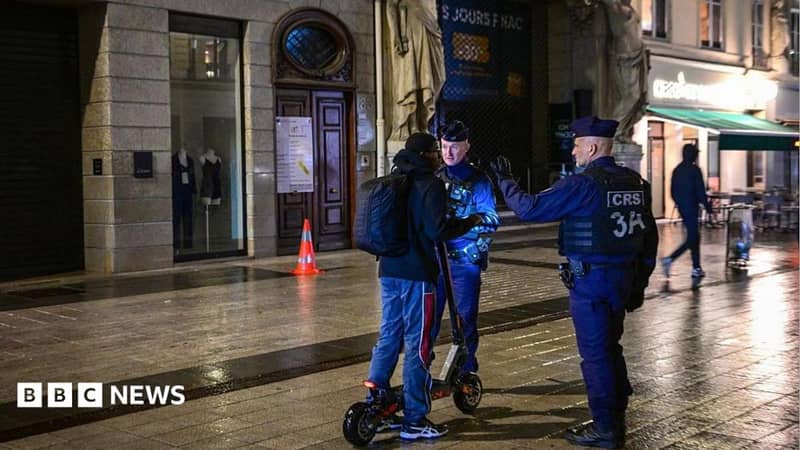
French authorities have imposed curfews in parts of Paris and other cities after nationwide riots overwhelmed police, the BBC reports. A confrontation that grew from school protests has reached the point where the government is restricting movement to regain control. The immediate change is concrete: the response now extends beyond confronting people involved in violence to limiting when others can be outside. That brings the consequences of the unrest into the lives of residents who may have taken no part in it.
The New York Times traces the escalation through the injury of a French student struck by a tear gas grenade. Its reporting places that injury within a wider confrontation over policing and living conditions. Those grievances matter to the sequence: school protests became a national conflict, police were overwhelmed, and authorities imposed curfews. The supplied accounts do not establish that every city followed the same course or that everyone involved wanted the same thing. They do establish that the dispute has expanded beyond its original setting, leaving the government confronting both violence and anger about how the state exercises its authority.
The curfews give authorities a means of restricting movement; they do not, by themselves, settle either grievance. Restoring order and restoring confidence involve different demands on the government. People need protection from violence, and the use of police force remains part of the dispute they are living through. A restriction can be announced more readily than confidence can be restored. Governments do tend to favour the part with an announcement.
The significance is that France's response has moved from policing a confrontation to restricting ordinary public life across parts of several cities. That may constrain the unrest, but it also broadens the reach of the government's decisions. The underlying political problem survives the curfew: authority has to protect people while answering for how it treats them.
All episodes and how to subscribe →